
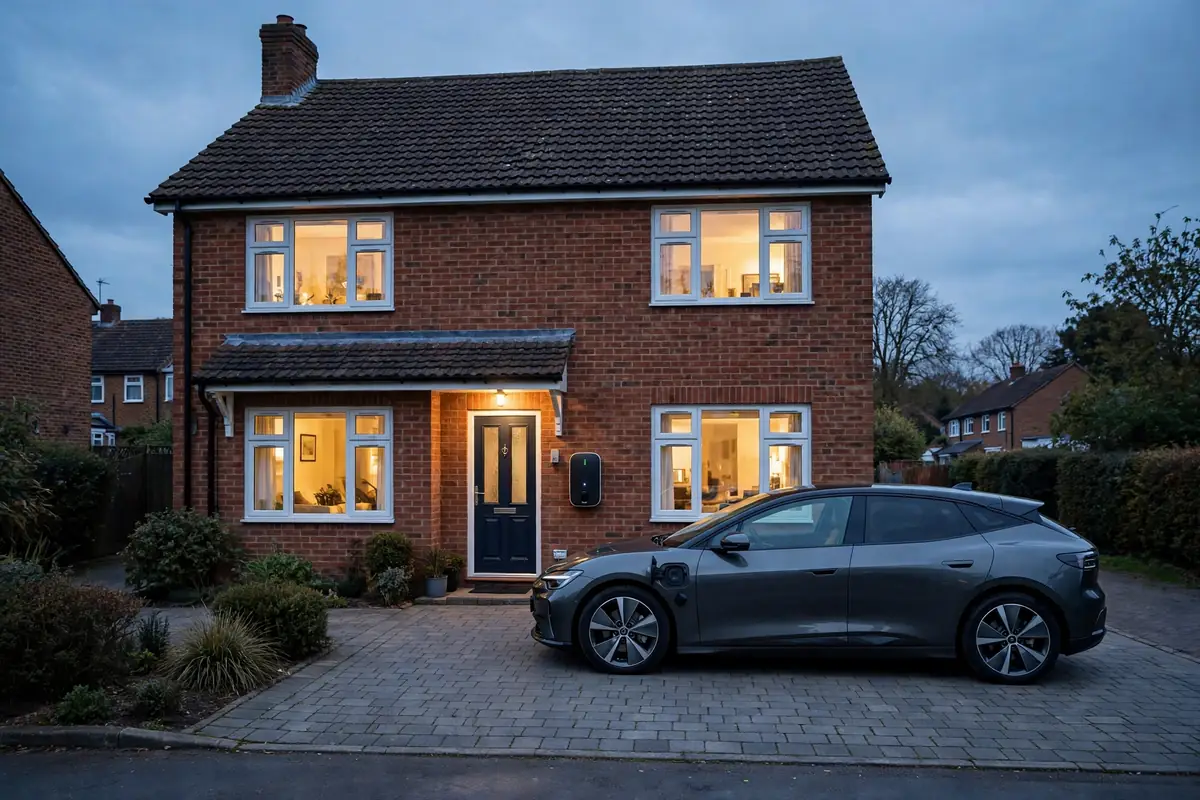
Buying the car is only the first step. Electric vehicle ownership brings a different daily rhythm from petrol or diesel motoring: charging instead of filling up, fewer routine service items, and running costs that depend heavily on how and where you plug in. For most UK drivers who can charge at home, it is a genuinely easier way to own a car.
This guide covers the real-world essentials of owning an electric car in the UK: charging at home and in public, running costs, battery care, servicing, insurance and the practical details that make EV life work.
Charging: the heart of electric vehicle ownership
Most EV charging happens at home, overnight, on a wallbox typically rated at 7kW. A home charge point turns the car into something you simply keep topped up, like a phone: plug in when you get home, unplug in the morning with a full battery. If you have a driveway or garage, this is the single biggest quality-of-life advantage of EV ownership.
Public charging fills the gaps. Rapid chargers on motorways and trunk roads can add substantial charge during a coffee stop, while slower destination chargers suit shopping trips and workplaces. Drivers without off-street parking use a mix of public chargers, workplace charging and, in some areas, lamppost charge points. Planning longer journeys around charging stops quickly becomes second nature.
Running costs: where EVs save money
Electricity per mile usually costs less than petrol or diesel per mile, especially for drivers on an off-peak home tariff who charge overnight. The saving depends on your tariff and charging mix: home charging at off-peak rates is the cheapest way to run any car, while heavy reliance on rapid chargers narrows the gap.
Maintenance costs also tend to be lower because an electric motor has far fewer moving parts and there is no engine oil, exhaust system or clutch to maintain. Servicing still matters, though: brakes, tyres, suspension, coolant for the battery system and software all need attention, as our EV servicing guide explains in detail.
Battery care and longevity
The battery is the most valuable component in the car, and modern EV batteries are lasting far longer than early sceptics predicted. Everyday habits help: avoid leaving the car at 100% charge for long periods if your manufacturer advises a daily limit, do not run it to empty regularly, and limit very frequent rapid charging if you want to be kind to the pack. The car manages most of this automatically through its battery management system.
Most manufacturers warrant the battery for around eight years, with a guaranteed minimum retained capacity. Cold weather temporarily reduces range because batteries are chemical devices; preconditioning the cabin while plugged in softens the effect on winter mornings.
Servicing, MOT and repairs
EVs follow a normal service and MOT rhythm. The annual MOT applies from three years old just as it does to any car, and our MOT and service guide explains how the two work together. Servicing focuses on inspection, brake fluid, cabin filters, tyres and software updates rather than engine work.
Tyres deserve attention: instant torque and battery weight can wear them faster, which is why our tyre services guide is worth a read for EV drivers too. If you are still deciding between electric and hybrid, our hybrid servicing guide shows what maintenance looks like on the halfway step.
Insurance, tax and everyday practicalities
Insurance for EVs has historically been a little higher than for equivalent petrol cars, mainly because of repair costs and parts availability, though the gap moves as the market matures. Get quotes on specific models before you buy, because group ratings vary widely between electric cars.
Vehicle tax rules for EVs have been changing, so check the current position for your car’s registration date rather than assuming electric means exempt. Company car drivers still benefit from low benefit-in-kind rates, which is why so many EVs arrive through salary sacrifice and fleet schemes. And if you are financing the purchase, our repair finance guide covers how owners spread larger maintenance bills, a budgeting habit that suits any car.
Getting a home charger installed
If you have off-street parking, a dedicated home charge point is the upgrade that makes EV ownership feel effortless. Installation is carried out by a qualified installer who fits the wallbox, connects it to your consumer unit with its own circuit, and sets up the accompanying app. Most installations are completed in a few hours. Smart chargers let you schedule charging for off-peak hours automatically, so the car fills up at the cheapest rate while you sleep.
Before installation, the installer will check your supply and may ask your distribution network operator for approval on higher-powered units, which they handle on your behalf. Flats and rented homes can also work: the practical route is a conversation with the landlord or freeholder, since the long-term value of a charge point increasingly counts in a property’s favour.
Living with an EV day to day
The daily experience is where converts are made. Electric cars are quiet, smooth and simple to drive, with instant response that makes town driving relaxed. Many owners use one-pedal driving in traffic, precondition the cabin from their phone on cold mornings, and plan the week around one or two home charges rather than any thought of a petrol station. The routine is different from fuel ownership, and for most people it quickly feels easier.
Finally, remember that range figures are a guide, not a promise. Weather, speed, load and driving style all move real-world range up or down, so judge an EV by how it fits your actual week of driving rather than by the largest number on a brochure. For most owners, the fit is comfortable within a few weeks of settling into the charging routine.
Is electric vehicle ownership right for you?
EV ownership suits drivers who can charge at home or work, cover predictable daily distances, and value low running costs and a quiet, easy drive. It requires more thought if you regularly tow, cover very long distances at short notice, or have no reliable charging access at all. For the majority of UK households, the honest answer is that an electric car is not a compromise; it is simply a better tool for everyday driving.