
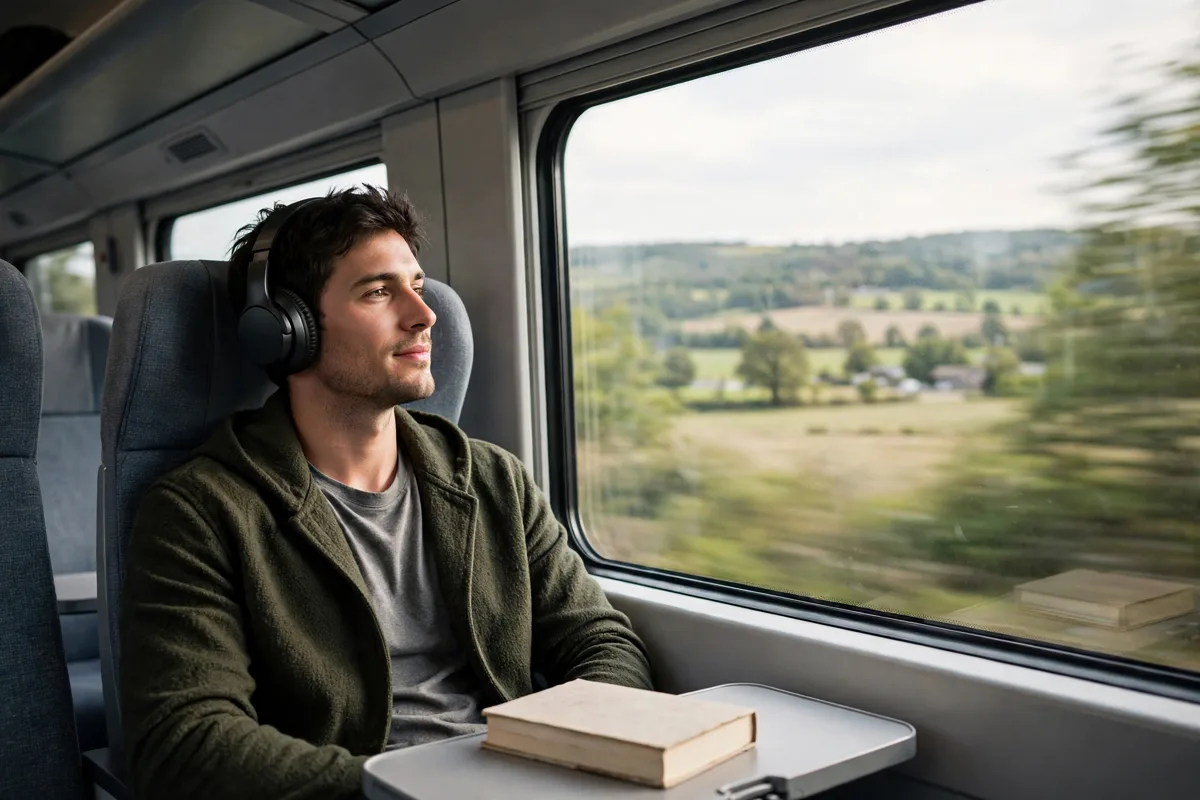
Sit on a train, a plane or a busy office floor and you will see them everywhere: headphones that swallow the roar of the world and leave only your music. The future of audio is being shaped by noise-cancelling tech, but how does it actually work — and where is it heading next? This explainer covers the elegant physics behind active noise cancellation (ANC), the difference between passive and active isolation, how modern adaptive systems listen and learn, and what the next generation of personal audio is likely to feel like. No engineering degree required.
The core trick: fighting sound with sound
Sound travels as waves of pressure in the air — peaks and troughs, like ripples on a pond. Active noise cancellation exploits a beautifully simple fact: if you play a sound wave that is the exact mirror image of an unwanted one — peak for trough, trough for peak — the two cancel each other out. Engineers call the mirror wave anti-noise, and the cancellation is known as destructive interference.
To do this in real time, noise-cancelling headphones carry tiny microphones on the outside of the earcups that listen to your surroundings. A processor inside the headphone analyses that sound and instantly generates the anti-noise signal, which is mixed into the audio you hear. Your music stays; much of the world fades. The processing has to happen in a fraction of a millisecond, before the sound reaches your ear — which is why ANC is a triumph of fast, miniaturised computing as much as acoustics, part of the same pocket-sized revolution described in our article on how smartphones are transforming our lives.
Passive vs active: two layers of quiet
Before any electronics, headphones block sound physically — that is passive isolation. Snug earcups, dense foam and well-sealed in-ear tips act like earplugs, and they work best on high-frequency sounds: chatter, clatter, the hiss of a cabin. This is the same principle as putting your hands over your ears, just engineered.
Active cancellation excels where passive struggles: low, steady, droning sounds. Engine hum, air-conditioning rumble, train and bus noise, the drone of a long flight — these repetitive low-frequency waves are predictable enough for the processor to cancel effectively. That is why ANC feels miraculous on a plane yet only denting on a crying baby or a nearby conversation: irregular, high-frequency sounds are physically harder to predict and cancel. The best headphones combine both layers, sealing out the highs passively and erasing the lows actively — a godsend on the long journeys in our guide to Maldives snorkelling and diving, where the flight is half the adventure.
Feedforward, feedback and adaptive ANC
Not all ANC is built the same way. Feedforward systems place the microphone outside the earcup, hearing the noise early and reacting fast — good for higher frequencies, but they never hear their own mistakes. Feedback systems put the microphone inside, near your ear, so they can check what you are actually hearing and correct it — excellent for low frequencies, slightly slower. Most quality headphones now use a hybrid of both.
The newest step is adaptive ANC: systems that continuously adjust their strength to your environment. Walk from a quiet street into a roaring station and the cancellation deepens automatically; some earbuds even adapt to the shape of your ears or how the tip seals. Transparency modes are the flip side of the same technology — the microphones pipe the outside world back in, so you can hear announcements or traffic without removing your earbuds. Gamers benefit too: our guide to the best PS5 exclusive games is best enjoyed with a headset that keeps the room out and the game world in.
What it cannot do — and why that matters
Honest limits are worth knowing. ANC reduces noise; it does not create silence, and it works least well on the sounds evolution trained us to notice — voices, alarms, sudden bangs. Some listeners also notice a faint pressure sensation or hiss from the processing, though modern systems have largely tamed both. And because cancellation needs power, ANC draws on the battery: switch it off on a quiet walk and your earbuds last far longer.
Those limits point exactly where development is going: smarter processors that can pick out and reduce specific sound types — a voice in a crowd, a keyboard clatter — rather than treating all noise as one problem.
Choosing noise-cancelling headphones: what actually matters
If you are shopping, a few checks separate the great from the merely good. Fit comes first: cancellation cannot work if sound leaks around the seal, so try in-ear tips in different sizes or check that over-ear cups close fully around your ears — glasses wearers should test with their frames on. Try the ANC in a genuinely noisy place if you can, not a quiet shop floor. Check that there is a transparency mode you can trigger without opening an app, and be honest about battery: decide whether you need cancellation to survive a working week of commutes or a single long-haul flight, and choose accordingly. Sound quality is personal, so listen to a favourite track and check voices sound natural rather than squeezed. Finally, look at the controls — physical buttons work with gloves and in the rain, while touch panels can misfire. None of this needs a spec sheet obsession; an hour of honest testing tells you more than any chart.
Where audio is heading
The direction of travel is clear. Noise cancelling is becoming adaptive and personalised by default, tuned to your ears and your surroundings rather than set at the factory. Spatial audio — sound that seems to come from fixed points around you — is merging with ANC in premium headphones. Hearables are taking on health roles, tracking activity and, in some markets, offering hearing assistance features. And the technology is spreading beyond headphones into cars, offices and even open-plan call systems, anywhere a predictable drone needs erasing.
For travellers, the practical effect is already here: quieter cabins, calmer commutes and easier concentration wherever you open a laptop — the sort of upgrade that transforms the long flights before the holidays in our California travel guide. The future of audio is not louder. It is quieter, smarter, and shaped around the listener.